

Ozempic Face and Muscle Loss: How to Prevent Both While You're Still Losing Weight
By Prolean Wellness Clinical Team · July 13, 2026
Preventing "Ozempic Face" & Muscle Loss During Weight Loss with GLP-1 Medications
Author: Prolean Wellness Clinical Team Sponsored Disclosure: This article discusses in-house services and supplements offered by Prolean Wellness.
FDA Disclaimer: The services and supplements discussed in this article are not intended to diagnose, treat, cure, or prevent any disease, including side effects of prescription weight loss medication. Statements have not been evaluated by the Food and Drug Administration. Always consult your prescribing physician before making changes related to your weight loss medication.
If you've searched "Ozempic face" or wondered whether GLP-1 medications like Ozempic cause muscle loss, you already know something a lot of people find out too late: the scale and the mirror don't always agree. You can be down 40, 60, 80 pounds and still be unhappy with what you see, a hollowed-out face, skin that doesn't sit right, or a body that feels softer and weaker than it looks lighter.
Individual responses may vary. Nutritional support is one aspect of overall wellness and is not a substitute for medical care.
Both of these are common, well-documented, and largely preventable if you address them early. This article covers what's actually happening, and how our GLP-1 Body Composition Program here in Scottsdale is built specifically to get ahead of both before they become hard to reverse.
Understanding "Ozempic Face" and Its Origins
What is "Ozempic Face"?
"Ozempic face" is the term people use for facial hollowing, sagging, and an aged appearance that can show up after rapid, significant weight loss, including weight loss from GLP-1 medications like Ozempic, Wegovy, Zepbound, or Mounjaro. It happens because the face carries fat pads that provide volume and support, and when those shrink quickly, skin that hasn't had time to adjust can look loose or deflated rather than simply slimmer.
It isn't a side effect specific to any one drug. It's a predictable result of losing fat faster than skin can keep pace, and it's the same reason people notice loose skin on the arms, stomach, and thighs after fast weight loss.
Addressing Muscle Loss with GLP-1 Medications
Does Ozempic cause muscle loss?
Yes, and it's one of the most common questions we get from clients starting a GLP-1 medication. According to a 2026 systematic review and meta-analysis of randomized controlled trials, lean mass makes up roughly 25% to 39% of total weight lost on GLP-1 and related incretin therapies, depending on the specific medication¹. That same research found the combination of weight loss and structured resistance training brought that number down to about 17.5%, suggesting that muscle loss is addressable with the right approach.
This is exactly why our program pairs body composition tracking with muscle-focused treatment and daily protein support, rather than leaving clients to figure out resistance training and protein targets on their own while managing a suppressed appetite.
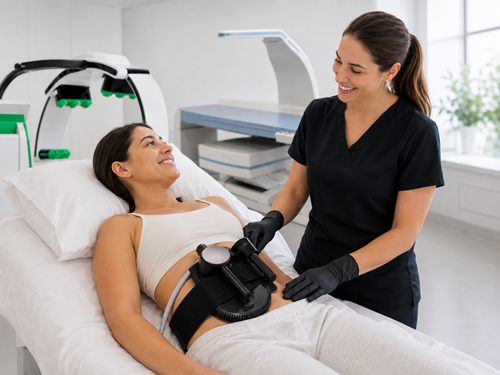
Maintaining muscle mass is an important aspect of healthy weight loss.
How to prevent loose skin and muscle loss while losing weight
The single biggest factor we see in how someone's skin and muscle turn out isn't the medication, it's timing. Clients who start supporting their skin and muscle while they're still actively losing weight consistently do better than clients who wait until the weight is already off and the skin is already loose.
That's the entire premise behind our GLP-1 Body Composition Program: instead of treating loose skin and muscle loss as problems to fix after the fact, we treat them as things to prevent in parallel with the weight loss itself, using a specific combination of in-clinic treatments, daily nutrition, and coaching.
Prolean Wellness GLP-1 Body Composition Program in Scottsdale
Start with a DEXA scan in Scottsdale
Everything in our program starts with a DEXA scan, a precise measurement of your fat mass, lean mass, and bone density, not just a number on a scale. It's how we know what's actually happening in your body and how we build a plan around your real numbers instead of guesswork. (We've written more detail on how a DEXA scan works and what to expect in a separate article, worth a read if you haven't had one before.)
Our recommended sequence for optimal body composition
For clients planning significant weight loss, this is the order we recommend most often. Your consult and DEXA scan will always set your specific plan, but here's the reasoning behind each part.
Emerald Laser and Muscle Sculpt for targeted support
Emerald Laser, then Muscle Sculpt, same day. We book these back to back on purpose. Emerald Laser is a low-level laser device that's FDA market-cleared for non-invasive reduction of overall body circumference, typically run as a series rather than a single session. Muscle Sculpt (our muscle stimulation and RF program) goes right after, on the same treated area, so a single visit addresses both fat and the muscle underneath it. Your coach sets the weekly frequency based on your DEXA results and goals.
T Shape 2 for skin tightening
T Shape 2 every 3 to 4 weeks. Skin tightening from radiofrequency works by stimulating your own collagen production, which is a gradual process. We deliberately don't stack it with your fat and muscle sessions, spacing it out every three to four weeks helps support skin elasticity on pace with the rate most clients are losing weight, without over-treating.
Daily nutritional support: protein, fiber, and greens
Protein, fiber, and greens, every day. A 2025 narrative review on dietary supplementation during GLP-1 treatment recommends a daily protein target of roughly 1.2 to 2.0 grams per kilogram of body weight, and notes that whey protein specifically, paired with resistance training, may help preserve lean body mass during weight loss². A separate 2025 clinical commentary recommends protein intake above 1.2 grams per kilogram per day, spread evenly across meals³. That target is genuinely hard to hit through food alone on a suppressed appetite, which is why we build Vegan Protein or Whey Protein into each client's daily plan. The same 2025 supplement review found that fiber and probiotics may help improve bowel regularity and ease some of the gastrointestinal side effects commonly reported with GLP-1 medications², which is the reasoning behind our Reds Superfood and Greens superfood blends being part of the daily protocol.

Proper nutrition, including protein and fiber, can play a role in supporting overall wellness during weight loss.
A sample monthly wellness plan with Prolean Wellness
Every plan is personalized at your consult, but here's roughly what a typical month looks like for a client in the active phase of weight loss through our programs:
In-clinic, multiple times weekly: Emerald Laser followed immediately by Muscle Sculpt, same visit
Roughly once every 3 to 4 weeks: T Shape 2 session for skin tightening
Every day: protein target hit through meals plus Vegan or Whey Protein, and a daily Reds and Greens serving
Ongoing: check-ins with your nutritionist and health coach to adjust targets as your weight changes
This is a months-long process by design. Most clients stay on some version of this rhythm for the full length of their weight loss, then step down to a lighter maintenance schedule once they've reached goal.
Safety & Considerations
Before embarking on any new wellness program or supplement regimen, especially when using GLP-1 medications, it is important to consult with your prescribing physician and the Prolean Wellness team. While our GLP-1 Body Composition Program is designed to support overall wellness during weight loss, contraindications for certain in-clinic treatments may exist, and nutritional supplements can interact with medications. We will thoroughly review your individual health profile to ensure the program is appropriate and safe for you. Dosage guidance for supplements will be personalized by our team based on your needs and goals. Individuals with pre-existing medical conditions or those taking prescription medications should exercise caution and seek professional medical guidance.
How to book your consultation in Scottsdale
The starting point is always a DEXA scan. Call us at (480) 477-6334 or visit the clinic at 9360 E Raintree Dr, Ste 103, Scottsdale, AZ to schedule your baseline scan and consult, or learn more about the full program on our GLP-1 Body Composition page.
Disclaimer
This content is for informational purposes only and does not constitute medical advice. Always consult a qualified healthcare professional before starting any new supplement or wellness program.
References
1. Eisa N, Barood O. Lean Mass Changes With Incretin Therapy Versus Lifestyle Intervention: A Systematic Review and Meta-Analysis of Randomised Controlled Trials. Diabetes Obes Metab. 2026. PubMed
2. Johnson BVB, Milstead M, Kreider R, Jones R. Dietary supplement considerations during glucagon-like Peptide-1 receptor agonist treatment: A narrative review. Obesity Pillars. 2025. PubMed
3. Noronha JC, Van Gaal LF, Neeland IJ, et al. Optimizing GLP-1 therapies for obesity and diabetes management. Obesity Pillars. 2025. PubMed